
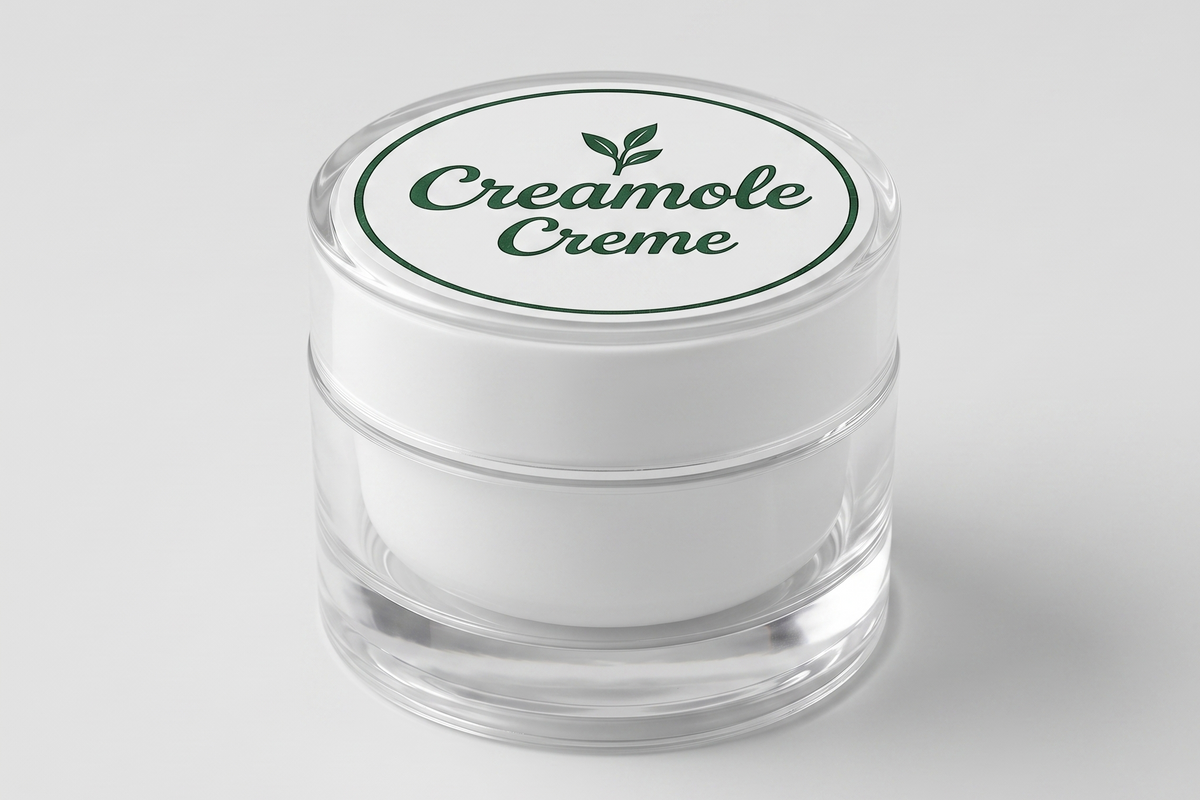
How does a cream for removing moles work?
--> -->The idea of simply being able to remove an unsightly mole at home with a cream may initially sound unusual to many. In this guide, we explain clearly what principle is behind such creams, how the application works, and what changes can occur during the process.
Quick overview: The most important at a glance
-->- Principle of action: Plant-based active ingredients penetrate specifically into the mole tissue and trigger a natural healing process. -->
- Main active ingredient: Cashew nut oil extract (Anacardium Occidentale) with a selective effect on pigmented skin cells. -->
- Process: Single application → Crust formation (1–2 days) → falling off on its own (7–14 days) → regenerated skin. -->
- Scientific basis: Traditional use for centuries and modern preparation for home use. -->
- Success rate: Very high with correct application and suitable skin changes. -->
- Important: Suitable for selected benign, especially raised skin changes.
--> -->
The scientific foundations: Why creams can work
-->The principle of selective cell action
-->Contrary to what many people assume, mole creams do not work exclusively on the principle of superficially removing the skin. Instead, they use the properties of certain plant substances that interact specifically with the treated tissue.
-->What does "selective" mean?
-->Selective effect means that active ingredients preferentially interact with certain cells or tissue structures, while the surrounding skin is stressed as little as possible with precise application.
-->The differences at the cellular level:
-->| Feature | Normal skin cells | Nevus cells |
|---|---|---|
| Melanin content | Normal to low | Frequently increased |
| Cell structure | Uniformly organized | More densely arranged |
| Tissue structure | Regular | Deviating cell clusters |
| Regeneration | High natural renewal | Depending on structure and depth |
These differences are an important reason why precise local application is crucial.
--> -->--> -->
The main active ingredient: Cashew nut oil extract in detail
-->Origin and traditional use
-->The cashew tree (Anacardium occidentale) originally comes from Brazil and is cultivated today in many tropical regions. While cashew nuts are mainly known as food, components of the cashew tree have traditionally also been used for various skin applications.
-->Traditional applications include:
-->- Warts and selected skin changes
- Calloused skin areas
- Pigmented skin areas
- Traditional external skin applications
The active components
-->Cashew nut shell oil contains several bioactive plant substances.
-->1. Anacardic acid
-->Anacardic acid belongs to the characteristic components of cashew shell oil and possesses properties that have been investigated in connection with the treatment of calloused skin structures.
-->2. Cardol and Cardanol
-->Cardol and Cardanol also belong to the phenolic components and complement the natural active ingredient profile.
-->3. Other phenolic compounds
-->Other plant compounds contribute to the complex composition of the extract.
--> -->The mode of action explained simply
-->The process can basically be divided into four phases:
-->- Penetration: The active ingredients enter the treated skin structure after preparing the surface. -->
- Interaction: The plant substances interact with the cell and tissue structures of the treated area. -->
- Reaction: The treated area begins to change visibly. -->
- Regeneration: Subsequently, the natural skin renewal phase begins.
--> -->
The application process: What happens during the treatment
-->Phase 1: The application
-->What you do:
-->- Cleanse the skin area carefully
- Prepare the surface according to the instructions
- Apply a very small amount of Creamole locally
- Leave on for about 20 minutes
- Remove cream residue afterwards
Minute 0–5: Absorption
-->After applying, the cream begins to interact with the prepared skin area. Through the previous preparation, the formulation can act more specifically on the desired area.
--> -->Minute 5–15: Reaction
-->During this phase, a noticeable warmth, tingling, or burning sensation may occur. Intensity and perception vary individually.
--> -->Minute 15–20: Completion of the application
-->After the recommended application time, the cream is removed. A longer application does not automatically mean a better result.
--> -->Why about 20 minutes?
-->The defined application time ensures a traceable and reproducible application process. It is crucial to perform the application according to the instructions.
--> -->--> -->
Phase 2: The first 24 hours
-->After removing the cream, the treated area can visibly change within the following hours.
-->Typical changes can be:
-->- slight to more pronounced redness
- increasing darkening of the treated area
- slight sensitivity
- beginning dryness
The exact course varies depending on skin type, size, condition, and body area.
--> -->--> -->
Phase 3: Crust formation
-->Day 1–2
-->In the further course, the treated skin area can darken and form a hard crust.
-->The crust serves several functions:
-->- it protects the underlying skin
- it forms a natural barrier
- it allows the skin to regenerate underneath
- it shows the visible course of the treatment
During this phase, the area should be manipulated as little as possible.
--> -->--> -->
Phase 4: Detachment and regeneration
-->Day 3–7
-->While the crust remains, the natural skin renewal continues underneath.
-->- the treated area continues to dry out
- new skin forms below the crust
- the crust can slowly loosen at the edges
Day 7–14
-->The crust can increasingly loosen and finally fall off on its own.
-->- new skin initially appears under the crust
- the area may initially look pink or lighter
- color and structure gradually match afterwards
Why should the crust not be removed?
-->The crust should fall off on its own as much as possible. Manipulation can disrupt the natural regeneration process.
--> -->--> -->
Phase 5: Maturation of the skin
-->Week 3–8
-->Even after the crust falls off, the skin continues to develop.
-->- the new skin gains stability
- the coloring gradually matches
- the surface structure normalizes
- redness can gradually recede
This process can take different lengths of time depending on skin type.
--> -->--> -->
Which factors influence the result?
-->1. Type of skin change
-->Particularly relevant are:
-->- Size
- Elevation
- Degree of callousing
- Body area
- individual skin structure
2. Precision of the application
-->One of the most important requirements is the precise application. The cream should only be applied to the desired skin area.
-->Recommended:
-->- use only a very small amount
- use an applicator
- work specifically
- follow the instructions exactly
3. Individual skin factors
-->Every healing course is individual. Differences can arise among others through skin type, body area, and personal regeneration.
--> -->4. Aftercare
-->The time after the actual application is at least as important for the final result as the application itself.
-->- leave the crust alone as much as possible
- avoid intense sun exposure
- care for the skin gently after detachment
- no aggressive mechanical irritation
--> -->
The role of other ingredients
-->Fig extract
-->Fig extract complements the plant-based formulation and is traditionally used in various skin care applications.
--> -->Citrus extract
-->Citrus extract is a component of the formulation and complements the plant-based active ingredient profile.
--> -->Talc mineral
-->Talc supports the consistency and ensures that the cream can be applied in a controlled and precise manner.
--> -->--> -->
Cream or classic removal?
-->Depending on the skin change and personal preference, different approaches are possible.
--> -->Creamole
-->- targeted application at home
- short application time
- no appointment required
- discreet application
- natural regeneration process
Laser
-->- treatment in a practice
- very targeted tissue removal
- different aftercare depending on the skin area
Surgical removal
-->- mechanical removal
- frequently with local anesthesia
- depending on the procedure, sutures may be required
Cryotherapy
-->- treatment by cold
- frequently used for certain warts
- possibly several applications required
--> -->
Frequently Asked Questions
-->Can the process be accelerated?
-->The skin should be given enough time. An additional or premature application can impair the natural course.
--> -->Why can the cream burn during application?
-->During the application time, burning or tingling may occur. Intensity and duration can vary from person to person.
--> -->Why is the surface prepared?
-->The preparation allows for a more uniform contact between the cream and the treated skin area.
-->It is crucial to prepare only the affected area according to the instructions.
--> -->What happens if the crust comes off too early?
-->In this case, the area should be treated particularly gently. It may need more time for complete regeneration.
--> -->Does Creamole also work on older skin changes?
-->The age of a skin change is not necessarily the deciding factor. Condition, size, and structure play a much larger role.
--> -->Can a skin change become visible again?
-->The course can vary individually. Crucial are especially a correct application and sufficient time for complete regeneration.
What is particularly important when using it?
- Carefully select the area of skin
- Read the instructions in full
- use only a very small amount
- apply the cream only locally
- Allow the required time for it to work
- allow the skin to regenerate undisturbed afterwards
Optimizing the results
Before use
- keep the area of skin clean and dry
- lay out all necessary items
- Read the instructions in full
- take a before photo for documentation
During regeneration
- do not manipulate the scab
- keep the area clean
- avoid intense friction
- avoid direct intense sunlight
After it falls off
- care for the skin gently
- use suitable sun protection
- do not perform any aggressive mechanical treatment
Summary: How does Creamole work?
The application process can be simply divided into five steps:
- 1. Preparation: clean and prepare the area of skin
- 2. Application: apply a very small amount locally
- 3. Working time: approximately 20 minutes
- 4. Progression: the treated area changes and forms a scab
- 5. Regeneration: the scab falls off and the skin regenerates
Ready to use it at home?
Creamole enables targeted, local application for selected benign skin changes – simply and discreetly at home.